

Participating Institutes
A Multi-Faculty Program
The research program covers a broad range of activities designed and hosted by six institutes in two faculties.
The formal curriculum includes advanced course work and seminars designed to help students to develop
a broad basis of research skills.
Faculty of Mathematics and Natural Sciences

IZMB
Research in the Institute for Cellular and Molecular Botany (Institut für Zelluläre und Molekulare Botanik, IZMB) is devoted towards understanding the interaction of plants with their environment on a molecular level. The institute is located in Kirschallee 1.
BIOB Abt. I
The research focus of the Plant Biodiversity Section (Former Nees Institute) of the Bonn Institute for Organismic Biology (BIOB) is plant biodiversity, including phylogenetic relationships, phytogeography, distribution, taxonomy, evolution, ecology and function. The Plant Biodiversity Section is linked with the Botanical Gardens Bonn. Is located in Meckenheimer Allee 170.
IMBIO
The Institute for Molecular Physiology and Biotechnology of Plants (Insitut für Molekulare Physiologie und Biotechnologie der Pflanzen, IMBIO) is formed by the department of Molecular Biotechnology (Prof. Dr. P. Dörmann). The department of Prof. Dörmann is located in Karlrobert-Kreiten-Str. 13.

IfP
Steinmann Institute for Geology, Mineralogy and Paleontology (Institut für Geologie, Mineralogie und Paleontologie) harbors different working groups. The Paleobotany group is involved in the teaching program of the M.Sc. Plant Sciences program. Paleobotany encompasses the study of fossil plants. As an interdisciplinary field between botany and geology, paleobotany embraces traditional areas of research such as taxonomy, phylogeny, and vegetation analysis, as well as more applied fields of study such as stratigraphy, facies analysis, paleoecology, and paleoclimatology. The institute is located in Nussallee 8.
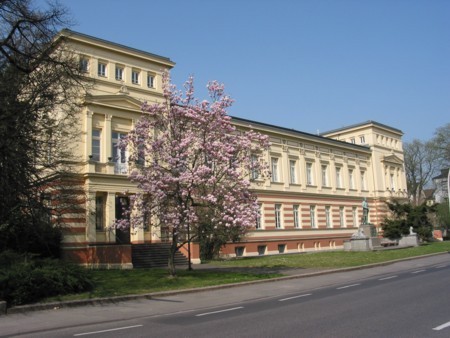
IfMB
The Institute for Microbiology and Biotechnology (Institut für Mikrobiologie & Biotechnologie, IfMB) focusses on the microbiological studies. The research focus of the institute encompasses physiological questions, pharmaceutical problems to food studies. The institute is located in Meckenheimer Allee 168.
INRES
The Institute of Crop Science and Resource Conservation (Institut für Nutzpflanzenwissenschaften und Ressourcenschutz, INRES) studies factors affecting crop production and the relationship with the environment and human life. The institute harbors the departments of Soil Science, Crop Genetics and Biotechnology, Crop and Horticultural Science, Plant Nutrition, Phytomedicine and Ecology of Cultural Landscape. The institute is located in different buildings in Bonn.

Botanical Gardens
The University of Bonn hosts one of the most beautiful and traditional botanicals gardens of Germany. The Botanical Gardens have two locations, the historic Palace Garden (Schlossgarten) around the Clemensruh Castle (Poppelsdorfer Schloss) and the Garden of Crop Plants (Nutzplanzengarten) at the Katzenburgweg. Research and education are the core functions of the Botanical Gardens. Plant material for research purposes is delivered to an average of 30 local and foreign research institutions every year. The main partner of the Botanical Gardens is the Plant Biodiversity section, as Prof. M. Weigend, Professor at the BIOB Abt. I, is at the same time the director of the Botanical Gardens.